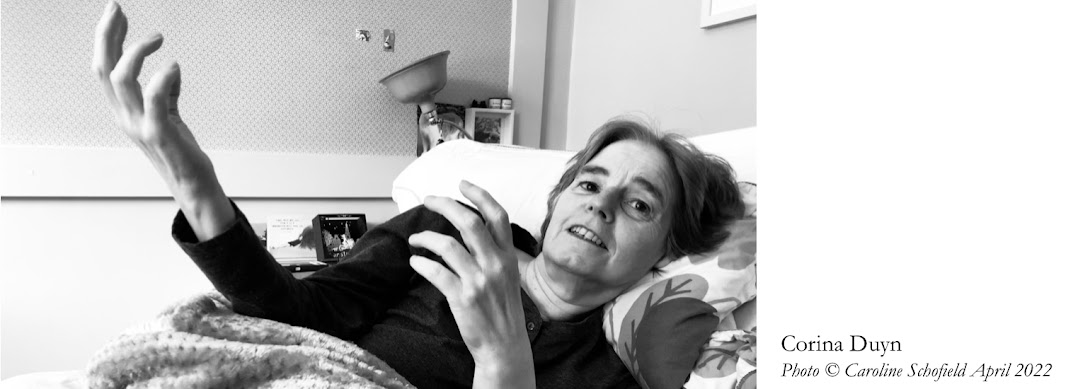
Transcript of lecture given by Corina Duyn as part of Diplomado Muñecoterapia, Chile 11th May 2019.
It was a pleasure and honour to speak with the students via Skype; briefly before my Powerpoint presentation, which was translated and presented by Penelope Glasse, and afterward for a very interesting Question and Answer session. Thank you all.
(Spanish translation is available on request)
 |
Thank you Andrea Markovits for inviting me to share my experience with you all. I had the pleasure of meeting Andrea at the first Broken Puppet Symposium on “Puppetry, Disability & Health in 2017 in Ireland. My name is Corina Duyn. I am a Dutch born artist, writer and puppet maker. I live in Ireland.
The Power of the Puppet

Puppetry, me and M.E.
I was born in the Netherlands (1962). Encouraged to be creative, I made my first rag doll at the age of ten, my first puppet at 15. The following decades I developed my own style of dolls and puppets, purely as a hobby. In the meantime I studied and worked as a palliative care nurse and social care worker while working in a nursing home, and group home for people with learning difficulties.
When I moved to Ireland in 1989 the people, the folklore and natural surroundings of my adopted country influenced my creations. Unintentionally I became a full time working artist. My Fantasy Folk Artist Dolls are in public and private collections in a great variety of countries.
In 1998 I started to teach puppet making in a group home for teenagers. It was a wonderful experience to see how eager these young people were to work with me and to engage in this art form. I clearly remember one young man of about 13, full of mischief. Predictably his puppet was to be a clown. The sculpted head was gorgeous, open, and funny. But when it came to making the hands, he ended up making fists.
It was a very powerful experience, and became the pivotal moment when I realized the power of art: especially the power of working with clay. The clay ‘does not lie’. The deepest fears, joy, wishes and challenges appear from our hearts, our minds, through our hands into the clay.
Unfortunately, I did not get to finish the project with the young people as I became very ill with the neurological illness M.E. (Myalgic Encephalomyelitis) in the summer of 1998.
In a very short time I lost the ability to look after myself, to walk properly, to sit up and talk, to remember, to read, to write, to prepare my food, or do even such simple tasks as open a tube of toothpaste. In terms of my work, I lost all finer skills to hold my tools and to manipulate the clay. As a result my creative output changed dramatically both in substance and intensity. By conducting a dialogue with my body, I created a visual and written account of life with illness, and explored the accompanying emotion, physical challenges, sudden joys and moments of gratitude.

One of the drawings was a connection to puppetry. The words in the drawing are:
“A puppet, not a great drawing, but…the puppet is me with M.E., I have little or no control over my body. WHO is the hand who keeps me upright, make me walk, make me move gracefully, or let me stumble at times, makes me stand my full length or let me buckle at the knees, makes the arms move or leave them hang like useless objects. Who is the hand that has control
What is the hand that holds the cross and moves 'my' strings at its will.
Can I become the hand over M.E., have control over me?
Hand, whatever you do, don't drop me altogether, hold on, but stop playing tricks…”
My creative work closely follows the journey through illness. The early years are documented in my book ‘Hatched, a Creative Journey Though M.E. (2006), which can be read for free on my website. When, many years later I came to accept recovery was not possible, I fulfilled a long held dream to study. Attending Disability Studies made me step out of the disability box out of solitude and into the world with a new creative vision, through sculptures, my Artist Book Into the Light. and back to puppetry. Armed with more conviction to tackle disability related issues through my work. As puppetry can break down the personal barriers, it gives us great scope to open up much needed conversations about disability, and other experiences of social disadvantage and oppression.

Human Rights, Disability and Puppetry
Article 30(2) of the United Nations Convention on the Rights of Persons with Disabilities: … ‘parties shall take appropriate measures to enable persons with disabilities to have the opportunity to develop and utilize their creative, artistic and intellectual potential, not only for their own benefit, but also for the enrichment of society.’
This statement is important on many levels, including the right to have access to the arts like everyone else. We should also be encouraged and supported to explore and share our experiences with the wider community. At times I struggle, like many others, to get the practical support to continue with my work. As well as a right, for me creating is also a human need.
The creative process helped me to understand my illness. It made me appreciate the person I have become, despite illness/disability. Although a solitary journey, creativity and especially puppetry has given me contact with people all over the world. It made me stay visible in a world when I am rarely seen outside my door. And hopefully I have enriched society with my work in the process.
I also believe that as a person with a disability I have the right to be the facilitator of an art project, and not just a participant in projects led by able-bodied people for people with disabilities. As is often the case…

Life Outside the Box, Disability Puppetry Project
While a member of the Irish Wheelchair Association (An organization in Ireland for people with physical disabilities, not just those using a wheelchair) the then Centre coordinator asked if I could facilitate a puppet-making project. We didn’t really know what that entailed, but after discussions with members and seeking financial assistance, we started our project in summer 2015.
Our group consisted of about 12 people with a variety of disabilities: acquired brain injury, MS, polio, congenital birth defects, and M.E. Ages 27 to 72. Over the course of about eight months we created nine puppets, a very large ‘disability’ box, and a large hand to help us out of the box. To document our project we published a book and filmed our puppets stepping out the disability box.
As I knew the participants in advance of the project, I was able to adapt tools and work methods to suit their specific needs. I drew heavily on my personal experience on how creative obstacles can be overcome.

For one young woman who has no lower arms I created a workstation so she could still sculpt most of the puppet’s head. I also adapted the mechanism so she could manipulate her beautiful puppet. A man with acquired brain injury felt uncomfortable to work in the large group, so I made sure he could work one to one on the large paper-maché hand. It was beautiful to see how he flourished. He linked this creative work with being a chef in his past. It breaks my heart that he is not encouraged to do more creative work.
Participants were amazed by their hidden abilities and it was great to see how they came up with solutions themselves. For example one man with MS who has very little strength left in his hands, taped sandpaper to the table, so he could sand the clay shoe by rubbing them over the sandpaper, holding it with both hands. Skills were exchanged and as a result the group became more cohesive. The focus shifted from disability to ability. Each week the puppet’s personalities and stories became more profound. One participant said that his puppet took on its ultimate personality because of the obstacles he faced along the way.
We all deal with vulnerability about our illness and disability. Being in this group, busy with our hands, there was a great sense of ease to talk about our lives, our challenges and hopes. It was a safe place. We certainly laughed a lot too, which was a great tonic.
We all had staff members to support us with practical work, which also made it possible for me to teach again, after a 17 year gap. We broke many personal boundaries, but perhaps also changed social perception and allowing us to explore new grounds.
We filmed the puppets stepping out of the disability box in our local shopping centre. We choose this public place on purpose, seeking interaction with the public. We are more than just our disabilities. It worked. Puppets make for easy conversation. People engaged with us. They didn’t see wheelchairs anymore they saw us!

For me, the puppet project represents pride, inclusiveness, freedom and empowerment. The benefits went beyond the making: One member with acquired brain injury was not able to make the puppet himself, although involved in every step of the way. It is still his puppet. During the filming he walked around with his puppet. He was one with his puppet. Beautiful to see.
Quote on Powerpoint slide:
“…“Whilst the project was about puppets coming out of their box, in reality, it was the service users that also ‘came out of their box’ to realise they could do more than they thought they were capable of. It was the most inclusive project that we ever did.”
Andrea Lloyd, Centre Coordinator at time of the project
Our project certainly caught the public’s eye. There were full spread articles in the local newspapers, and we had two well-attended launches at libraries. I was interviewed on radio on several occasions. Our video has been shown at Disability Film Festivals in Canada and London, and in our local cinema. Every three months an adapted one-minute version is screened on Irish national television. We also hosted an exhibition with our puppets and other creative work by the group and individuals. We celebrated our Ability.
I believed, and still believe, that the project broke many boundaries, and had great potential to be used further as communication tools about disability, for example in schools. It saddens me that these educational opportunities noted by the then Centre coordinator are not followed up by the person now in charge.
On a personal note, I am proud that as a person with a disability I was able to facilitate a project for and with other people with disabilities. There were so many astonishing and beautiful moments where believes of inability were overcome and became sources of inspiration; where characters appeared from under our hands – seemingly with fierce determination to be ‘born’ with their own story to tell.
Life Outside the Box. video, approx 4 min.
As I began to struggle more and more with the way we, the members, were being treated as if we were children, and not valuable members of society with our lived experiences, I had to stop going to the weekly meetings. I must say I miss meeting my fellow members, but I needed to protect my own mental wellbeing from the institutionalized ethos of the disability organization as a whole and the degrading treatment at the centre.
However, the Life Outside the Box project lives on. Emma Fisher and Laura Purcell-Gates referenced it in their research paper “Puppetry as reinforcement or rupture of cultural perceptions of the disabled body”. Create/Irish Arts Council, funders of the project, published a case study. Further details are on the Puppet Blog.
The project also let to the invitation by Emma Fisher to give a talk at the first Broken Puppet Symposium (2017) in Cork, Ireland. This was followed by invitations in 2018 to give the Key Note at the Broken Puppet 2 in Bath, UK, as well talks in Nottingham, Bristol, Brazil, Cork and Canada. Some in person, others via Skype or by pre-recorded video. I suddenly found myself in a world I did not know I was part of. How beautiful.
Since the project I have taught puppet making in my home studio (See Nationwide TV program) but currently only teach via distant learning. Some students have disabilities, or work with people with disabilities. Others simply like to enjoy learning a new art form, or use learned skills in their therapeutic practises. The distant learning course allows me to be able to teach while not restricted by my illness. In all cases, I am not overly concerned how beautiful the puppet is going to be. What I am most interested in to see is what stories the puppet has to tell. I encourage the student to truly engage with their work and explore the issues, thoughts, or desires, which might come to light. Puppets can go where people are afraid to go.

Puppetry and the Embodiment of Disability
Two great puppeteers who don't shy away from portraying the disabled body in their work are Emma Fisher and Nikki Charlesworth. Emma is an Irish puppet designer, puppeteer, Artistic Director of Beyond the Bark, an inclusive puppet and installation theatre and recently finished her PhD in Puppetry and Disability. Her Pupa production starts with the story of a puppet girl who is struggling with her disability, splits herself in two, casts off her disabled arm and banishes it to the room of forgotten limbs... Emma uses an exo-skeleton devise designed by Ivan Owen to animate her disabled arm in the production of Pupa. Disability becomes the story.
Recent graduate Nikki Charlesworth (UK) creates powerful work with one clear goal: the embodiment of disability. She beautifully explores the challenges of life with Cerebral Palsy through her autobiographical puppet. She animates with incredible accurate movements the many private and social situations she and others have encountered.

My own tentative depiction of disability through puppetry comes in the form of The Reflections Girls. A few years ago I walked into a dance studio using my walking sticks. I know how I walk, but seeing myself being surrounded by mirrors was a rather sobering experience. I turned away from the mirrors and sat down looking out the window and started writing in my diary. When brave enough I stood up and looked at my reflection in the mirror: What do I truly see? How does it feel? Do my thoughts change when I move the sticks behind my back? Are what I see and what I think the same?
I am hoping to tell their story properly on film, for now here is a very short abstract.
The Reflection Girls video, approx 2 min.

One of the challenges I faced during the past few years is that I don’t have the strength to hold the cross of my marionettes. I explored alternatives. Póilin is the result. I needed a puppet which I could animate from my wheelchair. Throughout this process I was very aware of my physical boundaries, and at the same time valued my ability.
The often overlooked therapeutic benefit of creating new work is that the brain is fully engaged. Waking up in the morning with the thought: “how could I make the puppet’s head move...”, takes the focus away from a painful or uncooperative body. Instead the focus is on something fun and productive. The therapeutic value is also in engaging with the finished puppet, and watch them come to life. Póilin certainly has taken on a personality of her own and in a way embodies my story.

During the past year I have been working on a new puppet project ‘Miracle. Miracle.’ Exploring Prejudice of chronic illness/disability. The story so far: At first glance you see a woman in a wheelchair. Covered in a blanket, she looks helpless. It evokes pity. When she removes her blanket, you see that she is wearing a miniskirt, kneepads, and a leather jacket. She challenges the perception of how a disabled person should dress and act. She stands up. Like me.
It confuses people when I step out of my wheelchair. I don’t fulfill the image the spectator has in her or his mind of a person in a wheelchair. I challenge their perception and prejudice.
Of course, a puppet can do anything – even roller skating. She takes her walking sticks from the back of her chair and proceeds to ‘ski’ on her roller blades.
I hope to tackle further social issues with this piece, for example gender identity and social class. Maybe a wheelchair pusher is a funky, gay teenager of colour with a radio on her shoulder... who knows!
I might not have the physical ability to be a puppet show performer, but I have every intention to continue making puppets and to tell my story through giving talks, teaching, and by writing and directing puppet films.

The Power of the Puppet
Puppetry is an incredible powerful medium to tell a story and to provoke empathy. It gives us scope to open up much needed conversations about disability, and other experiences of social disadvantage and oppression. Their imagery is provocative for use in protests. To finish, I believe that Puppetry is a wonderful healing and transformative art-form for the maker as well as the spectator.
Many thanks for your interest in my work.
Corina
Please take time to consider the topics for discussion. These are only guidelines, so please feel free to discus your own thoughts and issues which may have arisen.
I will answer any questions later via our Skype meeting, and gladly communicate via email at a later stage.
 |
| Students and Andrea Markovits at Diplomado Muñecoterapia, Chile, and Corina via Skype from Ireland |
 |
| students at Diplomado Muñecoterapia, Chile |
Abstracts of this paper may be quoted. Please reference Corina Duyn, “The Power of the Puppet”, Presentation on Puppetry, Disability and Health, by Corina Duyn, at Diplomado Muñecoterapia, 11 May 2019. www.corinaduyn.com
https://corinaduyn.blogspot.com/2019/05/the-power-of-puppet-presentation-on.html
https://corinaduyn.blogspot.com/2019/05/the-power-of-puppet-presentation-on.html
Further reading/viewing:
Website: www.corinaduyn.com
Facebook: www.facebook.com/corinaduyn
Instagram: www.instagram.com/corinaduyn
Email: corina.duyn@gmail.com


